

All You Need Is Love Film
| "All You Need Is Love" | ||||
|---|---|---|---|---|
 Usa flick sleeve | ||||
| Single by the Beatles | ||||
| B-side | "Baby, You're a Rich Man" | |||
| Released | seven July 1967 | |||
| Recorded | xiv, xix, 23–26 June 1967 | |||
| Studio | Olympic Audio and EMI, London | |||
| Genre | Pop,[1] psychedelia[2] [3] | |||
| Length | iii:57 | |||
| Characterization | Parlophone, Capitol | |||
| Songwriter(s) | Lennon–McCartney | |||
| Producer(s) | George Martin | |||
| The Beatles singles chronology | ||||
| ||||
| Alternative cover | ||||
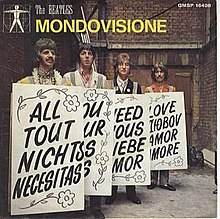 Italian picture sleeve, showing the Beatles in advance promotion for the Our World circulate | ||||
"All You Need Is Honey" is a song by the English rock ring the Beatles that was released as a not-album single in July 1967. It was written past John Lennon[4] and credited to the Lennon–McCartney partnership. The song was Britain'south contribution to Our World, the first live global television link, for which the band were filmed performing it at EMI Studios in London on 25 June. The program was broadcast via satellite and seen by an audience of over 400 million in 25 countries. Lennon'due south lyrics were deliberately simplistic, to allow for the evidence'southward international audience, and captured the utopian ideals associated with the Summer of Love. The single topped sales charts in Britain, the Us and many other countries, and became an anthem for the counterculture'southward embrace of flower ability philosophy.
Our Earth coincided with the peak of the Beatles' popularity and influence, following the release of their album Sgt. Pepper'due south Lonely Hearts Club Band. Rather than perform the song entirely live, the group played to a pre-recorded backing rails. With an orchestral arrangement by George Martin, the song begins with a portion of the French national canticle and ends with musical quotations from works such equally Glenn Miller's "In the Mood", "Greensleeves", Bach'due south Invention No. 8 in F major, and the Beatles' 1963 hit "She Loves You". Adding to the circulate'southward festive atmosphere, the studio was adorned with signs and streamers, and filled with guests dressed in psychedelic attire, including members of the Rolling Stones, the Who and the Pocket-size Faces. Brian Epstein, the Beatles' manager, described the functioning as the band's "finest" moment.[5]
"All You lot Need Is Love" was later on included on the Usa Magical Mystery Tour album and served as the moral for the Beatles' 1968 blithe film Yellowish Submarine. Originally broadcast in black-and-white, the Our Earth performance was colourised for inclusion in the Beatles' 1995 Anthology documentary series. While the song remains synonymous with the 1967 Summer of Honey ethos and provided the foundation for Lennon's legacy every bit a humanitarian, numerous critics found the message naive in hindsight, particularly during the 1980s. Since 2009, Global Beatles Mean solar day, an international commemoration of the Beatles' music and social message, takes place on 25 June each year in tribute to their Our World functioning.
Groundwork and inspiration [edit]

On 18 May 1967, the Beatles signed a contract to announced as Britain's representatives on Our Earth, which was to be circulate live internationally, via satellite, on 25 June.[4] The Beatles were asked to provide a vocal with a message that could be easily understood by everyone,[7] and using "bones English" terms.[8] The band undertook the consignment at a time when they were considering making a tv special, Magical Mystery Tour,[ix] and working on songs for the blithe film Yellow Submarine, for which they were contractually obliged to United Artists to supply four new recordings.[ten] "All You Need Is Beloved" was selected for Our Earth for its gimmicky social significance over the Paul McCartney-written "Your Mother Should Know".[xi] [nb one] In a statement to Melody Maker magazine, Brian Epstein, the band'southward manager, said of "All Y'all Demand Is Dearest": "It was an inspired vocal and they actually wanted to give the earth a message. The dainty thing virtually information technology is that information technology cannot be misinterpreted. It is a clear message saying that love is everything."[13] [fourteen]
John Lennon later attributed the song's uncomplicated lyrical statements to his liking of slogans and television advertising.[fifteen] He likened the vocal to a propaganda slice,[sixteen] calculation: "I'm a revolutionary creative person. My art is dedicated to alter."[15] Author Mark Hertsgaard views it equally the Beatles' "well-nigh political song yet" upwardly to 1967 and the origins of Lennon'due south posthumous continuing equally a "humanitarian hero".[17] The song's advocacy of the all-importance of love followed Lennon'south introduction of the idea in his lyrics to "The Word" in 1965[xviii] [xix] and George Harrison's declaration in "Within You Without You", from the ring's recently released Sgt. Pepper'southward Lonely Hearts Gild Band album, that "With our honey, we could save the world".[twenty] [21]
The Beatles were unimpressed when Epstein beginning told them that he had arranged for their advent on Our Globe, and they delayed choosing a song for the broadcast.[22] In their interviews for The Beatles Anthology in the 1990s, McCartney and Harrison say they were unsure whether "All You lot Need Is Love" was written for Our Globe, while Ringo Starr and George Martin, the Beatles' producer, country that it was.[23] McCartney said: "It was certainly tailored to [the broadcast] once nosotros had it. Merely I've got a feeling it was just one of John's songs that was coming anyway."[24] In McCartney's recollection, the song was entirely Lennon's, with Harrison, Starr and his own contributions bars to "advertisement-libs" at the stop of the recording.[25]
Composition and musical structure [edit]
Main portion [edit]

"All Yous Need Is Love" contains an asymmetric time signature and circuitous changes.[26] Musicologist Russell Reising writes that, although the song represents the acme of the Beatles' overtly psychedelic stage, the change in metre during the verses is the sole example of the experimental aspect that typifies the band's work in that genre.[2] The chief verse blueprint contains a total of 29 beats, split into 2 7
four measures, a single bar of 8
4 , followed by a i bar return of vii
4 before repeating the blueprint. The chorus, withal, maintains a steady iv
4 beat with the exception of the last bar of half-dozen
4 (on the lyric "dearest is all you demand"). The prominent cello line draws attention to this departure from popular-single normality, although it was non the first time that the Beatles had experimented with varied metre within a single song: "Love You To" and "She Said She Said" were earlier examples.[27]
The vocal is in the fundamental of M and the verse opens (on "There's nix you can do") with a G chord and D melody note, the chords shifting in a I–5–vi chord progression while the bass simultaneously moves from the tonic (One thousand) notation to the root notation of the relative minor (Due east small), via an F ♯ ,[28] supporting a first inversion D chord. After the poetry "acquire how to play the game, it's easy", the bass alters the prolonged 5 (D) chord with F ♯ , E, C and B notes.[29] The song includes a dramatic apply of a dominant or V chord (here D) on "It'southward easy."[thirty] The "Love, honey, beloved" chant involves chords in a I–V7–vi shift (G–D–Em)[31] and simultaneous descending B, A, Yard notes with the concluding G annotation corresponding not to the tonic 1000 chord, simply acting as the third of the Eastward minor chord; this also introducing the Due east notation of the Em chord as a 6th of the tonic G scale. Supporting the same melody notation with different and unexpected chords has been termed a feature Beatles technique.[32]
Co-ordinate to Reising, the lyrics advance the Beatles' anti-materialistic bulletin and are an "anthemic tribute" to universal dearest in which "nothing is tempered or modulated".[33] He says that Lennon favours words such as "nothing", "no one", "nowhere" and "all", thereby presenting a series of "extreme statements" that conclude with "the concluding reversals of 'All y'all need is love' and 'Beloved is all you need'".[two]
Quotations and coda [edit]
On the Beatles' recording, the song starts with the first few bars of the French national anthem, "La Marseillaise", and contains elements from other musical works, such equally Glenn Miller's 1939 hitting "In the Mood". This use of musical quotations follows an approach commencement adopted by the Beatles in Harrison'south composition "It's All Too Much",[34] which similarly reflects the credo behind the hippie motion during the 1967 Summer of Dear.[35] George Martin recalled that in "All You Need Is Love" "the boys ... wanted to freak out at the end, and just become mad".[36] During the long coda, elements of other musical works can exist heard, including "Greensleeves", Invention No. 8 in F major (BWV 779) by J. S. Bach, "In the Mood", and the Beatles' own songs "She Loves You" and "Yesterday".[37] The outset of these 3 pieces had been included in the system by Martin, while "She Loves You" and "Yesterday" were the result of improvisation by Lennon during rehearsals.[38] [nb ii]
Like musicologist Alan Pollack, Kenneth Womack views the "She Loves You" refrain as serving a similar purpose to the wax models of the Beatles depicted on the cover of Sgt. Pepper, beside the real-life band members, and therefore a farther case of the group distancing themselves from their past.[xl] In his volume Rock, Counterculture and the Avant-Garde, author Doyle Greene describes the combination of the "Love is all you need" refrain, "She Loves Yous" reprise, and orchestral quotations from Bach and Miller as "a joyous, commonage anarchy signifying the utopian dreams of the counterculture topped off with a postmodern fanfare".[41]
Recording [edit]
Bankroll track [edit]
The Beatles began recording the backing track for the song at Olympic Sound Studios in Barnes, due south-due west London, on 14 June 1967.[four] [42] The producers of Our Earth were initially unhappy near the use of a backing track for the broadcast, simply Martin insisted, saying, "we can't merely go in front of 350 million people without some work".[38] The initial line-up was Lennon on harpsichord, McCartney on double bass with a bow, Harrison on violin – three instruments that were unfamiliar to the musicians[43] – while Starr played drums.[44] The band recorded 33 takes, earlier choosing the 10th take every bit the best. This performance was transferred onto a new iv-rail tape, with the iv instruments mixed into i track.[44] The engineers at Olympic thought the Beatles displayed a surprising lack of care during this process,[iv] a sign, according to author Ian MacDonald, of the group'due south new preference for randomness in contrast to the loftier production standards of Sgt. Pepper.[45]
From 19 June, working at Studio 2 in EMI Studios (now Abbey Road Studios),[46] the Beatles recorded overdubs including piano (played by Martin), banjo, guitar and some vocal parts.[38] Among the latter were the "Dearest, beloved, dear" refrains, and a Lennon song over the song'due south choruses.[47] On 23 June, the ring began rehearsing the song with an orchestra, whose playing was also added to the backing rails.[46] On 24 June, the day earlier the circulate, the Beatles decided that the song would be their adjacent single.[46] Late that morning, a printing call was held at EMI Studios, attended by over 100 journalists and photographers, followed by farther rehearsals and recording.[46] Publicity photos were taken during the press phone call and rehearsals, and a BBC boob tube crew blocked the photographic camera angles required for the live functioning.[47] As part of this pre-circulate promotion, the Beatles posed in a thou beside the studio building, wearing boards that together spelt out "All Yous Need Is Dear"[48] and approximations of the song championship in 3 other languages.[49] [nb three]
Live broadcast [edit]
There was a tremendous feeling that [the Beatles] really did believe all this, and they'd very consciously written an anthemic slice that could be understood worldwide. This was the commencement fourth dimension Tv set had been beamed to so many countries, and plain almost of the listeners wouldn't be English language speakers. They wrote something really, really bones, and yet all the same got the countercultural message across.[52]
– Barry Miles, 2007
The Our World broadcast took place in the wake of the Arab–Israeli 6-Twenty-four hour period War and, for the Beatles, among the public furore caused by McCartney'due south admission that he had taken LSD.[53] On 25 June, the live manual cut to EMI Studios at 8:54 pm London time, about 40 seconds earlier than expected. Martin and engineer Geoff Emerick were drinking scotch whisky to calm their nerves for the task of mixing the audio for a live worldwide broadcast, and had to scramble to hide the bottle and glasses beneath the mixing desk subsequently being told they were nigh to continue air.[5] [38]
The Beatles (except for Starr, behind his drum kit) were seated on high stools, accompanied by a 13-slice orchestra. The band were surrounded past friends and acquaintances seated on the floor, who sang forth with the refrain during the fade-out. These guests included Mick Jagger, Eric Clapton, Marianne Faithfull, Keith Richards, Keith Moon, Graham Nash, Pattie Boyd (Harrison'south married woman), forth with Mike McGear and Jane Asher (McCartney's brother and girlfriend, respectively).[38] The studio setting was designed to reflect the communal aspect of the occasion while also demonstrating the position of influence that the Beatles held among their peers, especially following the release of Sgt. Pepper.[54] [nb 4] Many of the invitations were extended through Beatles aides Mal Evans and Tony Bramwell, who had visited various London nightclubs the night earlier the broadcast.[59]

A colourised frame of McCartney and Lennon performing "All You Need Is Beloved" on Our Globe. Music journalist Peter Doggett has described the Beatles' performance as "one of the strongest visual impressions" from the Summer of Love.[sixty]
Likewise among the studio audience were members of the Small Faces[25] and the design commonage the Fool.[61] [nb 5] Balloons, flowers, streamers and "Love" graffiti added to the celebratory atmosphere. The Beatles and their entourage were dressed in psychedelic clothes and scarves; in his study on the performance, Barry Miles likened the setting to a medieval gathering, broken merely by the presence of modern studio equipment such as big headphones and microphones.[63] According to Michael Frontani, an associate professor of communications, whereas Sgt. Pepper showed the Beatles as artists and "serious musicians", Our Globe emphasised their identity every bit members of the hippie counterculture.[64] [nb half dozen]
The segment was directed by Derek Burrell-Davis, the head of the BBC's Our World project.[65] It opened with the band playing "All You Need Is Love" for about a minute, before Martin, speaking from the studio control room, suggested that the orchestra should take their places for the recording every bit the record was rewound.[38] The BBC presenter, Steve Race, announced that the Beatles had just recorded this performance and were about to complete the recording live.[47] In fact, in writer John Winn's clarification, Race's statements were part of the "staged" attribute of the segment, which purported to show the Beatles at work in the studio: the opening footage of the band (merely rehearsing over the bankroll track) had been filmed earlier, and by the time Martin appeared to be issuing instructions, the orchestra were already seated in Studio 1.[47] [nb 7] The Beatles, accompanied past the orchestra and the studio guests, and so performed the entire song, overdubbing onto the pre-recorded rhythm rails. In addition to the lead and backing vocals and the orchestra, the alive elements were McCartney's bass guitar part, Harrison'due south guitar solo and Starr'due south drums.[39] [66] In the opinion of music critic Richie Unterberger, the performance of "All You Need Is Love" is "the all-time footage of the Beatles in the psychedelic period" and "captures Flower Power at its zenith, with enough blasphemy to avoid pomposity, what with the sandwich boards of lyrics, the florid clothing and decor, and celebrity guests".[67]
Final overdubs [edit]
Nosotros were big enough to control an audience of that size, and information technology was for beloved. It was for love and bloody peace. It was a fabulous fourth dimension. I even get excited at present when I realise that's what it was for. Peace and dear, people putting flowers in guns.[24]
– Ringo Starr, 2000
Lennon, affecting indifference, was said to exist nervous almost the circulate, given the potential size of the international TV audience. Later on 25 June, dissatisfied with his singing, he re-recorded the solo verses for use on the single.[39] [66] On 26 June, in EMI's Studio 2, Lennon'south vocal was treated with ADT,[68] and Starr overdubbed a drum coil at the start of the runway, replacing a tambourine part.[66] [69]
The program was shown in blackness-and-white since colour television had yet to embark broadcasting in Great britain and most of the globe. The Beatles' footage was colourised, based on photographs of the event, for the 1995 documentary The Beatles Anthology.[70] Over the documentary's end credits, a snippet of studio conversation from the 25 June overdubbing session includes Lennon telling Martin: "I'g set up to sing for the earth, George, if you can but requite me the backing …"[71] The colour version of the ring's Our World appearance also appears on the Beatles' 2015 video compilation 1.[72]
Release and reception [edit]
"All You Demand Is Love" was issued in the UK on 7 July 1967, on EMI's Parlophone label, with "Baby, You're a Rich Homo" as the B-side.[73] The US release, on Capitol Records, took identify on 17 July.[74] In his contemporary review for Melody Maker, Nick Jones said the Beatles represented the "progressive avant-garde" in their approach to singles releases, and that "All Y'all Need Is Dearest" was "another milestone in their very phenomenal career". He described the song as a "cool, calculated contagious Beatles singsong" that was more immediate than "Strawberry Fields Forever", and concluded: "The message is 'honey' and I hope everyone in the whole wide earth manages to get it."[75] The single entered the Record Retailer chart (later the Britain Singles Chart) at number 2 before topping the listings for three weeks.[76] In the United states of america, it topped the Billboard Hot 100 for a week.[77] [78] The song was a number 1 hit in many other countries.[38] [79] It was also the subject of a copyright dispute betwixt EMI and KPM, the publisher of "In the Mood", later in July. Since Martin had not checked the copyright condition of Miller'due south slice before incorporating information technology into the coda, EMI were obliged to pay royalties to KPM.[39] On eleven September, "All Yous Demand Is Dear" was certified Gold by the Recording Industry Association of America.[lxxx]

The Aegean Sea, off the coast of Greece. In the weeks following the single's release, the Beatles holidayed on the Aegean in search of an island on which to establish a commune in the mode of Aldous Huxley.[81]
The single coincided with the pinnacle of the Beatles' popularity and influence during the 1960s, following the release of Sgt. Pepper.[82] In his retrospective feature on the song in Rolling Rock, Gavin Edwards writes that "All You Demand Is Love" provided "the sing-song anthem for the Summer of Dearest, with a sentiment that was simple but profound".[38] Co-ordinate to historian David Simonelli, such was the band'southward international influence, it was the song that formally announced the arrival of blossom ability credo as a mainstream concept.[83] The Beatles followed up the utopian spirit of Our World in their activities over July and Baronial,[84] during their first summertime free of tour commitments.[85] In belatedly July, the band investigated the possibility of ownership a Greek island with a view to setting up a hippie-style district for themselves[86] and members of their inner circumvolve.[87] After sailing around the Aegean Body of water and approval a location on the island of Leslo,[87] the Beatles decided against the idea and returned to London.[88] [89] In early Baronial,[90] Harrison and a small entourage made a well-publicised visit to the international hippie capital letter of Haight-Ashbury, in San Francisco.[vii] [91]
Writing in 2001, Peter Doggett said that the Beatles' performance on Our World "remains one of the strongest visual impressions of the summer of honey";[60] Womack describes it as "flower power'due south finest moment".[92] Rolling Stone ranks "All You Need Is Love" 370th on its list of the "500 Greatest Songs of All Time"[93] and 21st on its "100 Greatest Beatles Songs" list.[23] Mojo placed it at number 28 on a like list of the best Beatles songs. In his commentary for the magazine, producer and musician Dave Stewart admired the rails's "jumbled-up mix of music – marching band and stone'n'roll" and recalled the Beatles' Our World advent as "a signal for those [of the states] who felt we were trapped in a mental infirmary in some suburban town to pause out".[94] In 2018, the music staff of Time Out London ranked "All Yous Need Is Love" at number 4 on their list of the best Beatles songs.[95]
In November 1967, "All Y'all Need Is Dear" was included on the American LP version of Magical Mystery Tour,[96] together with the band's other singles tracks from that year.[97] It was also included on the Yellowish Submarine soundtrack album, released in January 1969.[98] As a statement on the power of universal love, the song served as the moral in the Yellowish Submarine film;[99] [100] it plays over a scene where Lennon'due south character defeats the Blue Meanies by throwing the give-and-take "Honey" at their evil Flying Glove.[101] [nb 8] The song is also featured in Cirque du Soleil'south testify Love, based on the songs of the Beatles. It was sequenced as the closing track of the 2006 soundtrack album.[68] [nb 9]
Cultural responses and legacy [edit]
[edit]
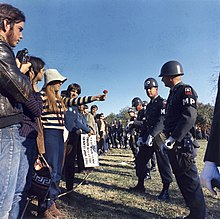
A demonstrator offers a flower to military policemen during an anti-Vietnam War sit-in in October 1967 (photo by Marc Riboud). "All You Need Is Love" provided an canticle for the flower power motility.
In a 1981 commodity on the musical and societal developments of 1967, sociomusicologist Simon Frith described "All You lot Need Is Love" as a "genuinely moving song" and said that, further to the touch on of Sgt. Pepper, the international broadcast confirmed "the Beatles' evangelical function" in a yr when "information technology seemed the whole world was waiting for something new, and the power of music was beyond doubt."[103] Psychiatrist and New Left advocate R.D. Laing wrote about the song'due south contemporary appeal:
The times fitted [the Beatles] similar a glove. Everyone was getting the feel of the world as a global hamlet – as us, one species. The whole human race was becoming unified under the shadow of expiry ... One of the most heartening things nigh the Beatles was that they gave expression to a shared sense of commemoration around the world, a sense of the aforementioned sensibility.[104]
Doyle Greene writes that considering of its presentation as the conclusion to Our World, "All Y'all Need Is Beloved" provided "a distinctly political statement". He says that the song was "selling peace" on a programme that aimed to foster international agreement in a climate of Cold War hostility, the Vietnam War and revolutionary unrest in the 3rd World.[16] By contrast, NME critics Roy Carr and Tony Tyler detected self-parody in the song, saying that the Beatles sought to debunk their elevated condition during the Summer of Dearest.[105]
According to author Jon Wiener, "All You lot Need Is Love" served as "the anthem of bloom power" that summer but also, like Sgt. Pepper, highlighted the ideological gulf between the predominantly white hippie move and the increasingly political ghetto culture in the US.[106] Wiener says that the song's pacifist agenda infuriated many student radicals from the New Left and that these detractors "continued to denounce [Lennon] for it for the rest of his life".[107] [nb x] He too writes that, in summertime 1967, "links betwixt the counterculture and the New Left remained murky", since a full dialogue regarding politics and rock music was notwithstanding a year abroad and would merely be inspired by Lennon's 1968 song "Revolution".[110]
In the mid 1970s, co-ordinate to Carr and Tyler, it was still "incommunicable" to hear the start of the French national anthem without launching into "All You lot Demand Is Love", yet fifty-fifty a contrite "reformed hippie" could "bellow tunelessly forth with this glorious, irreverent single without any real embarrassment – a mensurate of its internal strength and immovability".[105]
In 2005, a handwritten re-create of the lyrics sold at sale for $1.25 meg (equivalent to $1.73 million in 2021), more than than tripling the record for a lyric manuscript previously held past Lennon'due south "Nowhere Man".[111]
Retrospective criticism [edit]
Mayhap in the Sixties we were naive and similar children and subsequently everyone went dorsum to their rooms and said, "Nosotros didn't get a wonderful world of flowers and peace." … Crying for it wasn't enough. The thing the Sixties did was prove us the possibility and the responsibility nosotros all had.[112]
– John Lennon, 1980
In the decades following the tape's release, Beatles biographers and music journalists criticised the lyrics as naive and simplistic and detected a smugness in the message; the song's musical content was similarly dismissed equally unimaginative.[113] Ian MacDonald viewed it equally "ane of The Beatles' less deserving hits" and, in its manifestly chaotic production, typical of the band's self-indulgent work immediately after Sgt. Pepper.[45] Regarding the song's message, MacDonald writes:
During the materialistic Eighties, this vocal's title was the barrel of cynics, at that place being, obviously, any number of boosted things needed to sustain life on earth. It should, perhaps, be pointed out that this record was not conceived as a blueprint for a successful career. "All yous demand is love" is a transcendental argument, as truthful on its level every bit the principle of investment on the level of the stock exchange. In the idealistic perspective of 1967 – the polar opposite of 1987 – its championship makes perfect sense.[114]
Writing in 1988, author and critic Tim Riley identified the track's "internal contradictions (positivisms expressed with negatives)" and "swollen self-confidence ('it's easy')" as qualities that rendered it equally "the naive reply to 'A Solar day in the Life'".[115] Past dissimilarity, Marking Hertsgaard considers "All You Demand Is Love" to be amongst the Beatles' finest songs and one of the few highlights among their recordings from the Magical Mystery Tour–Xanthous Submarine era.[11] In his opinion, Lennon'south detractors fail to discern between "shallow and utopian" when ridiculing the song every bit socially irrelevant, and he adds: "one may as well complain that Martin Luther Rex was a poor vocaliser as criticize Lennon on fine points of political strategy; his function was the Poet, not the Political Organizer."[113] [nb 11]
Writing in 2017, Ludovic Hunter-Tilney of the Financial Times said that the vocal "appears hopelessly naive 50 years on" still its espousal of global connectedness had go increasingly relevant. In his view, through Our World, "'All You Need Is Beloved' marked a new affiliate in the earth'due south colonisation past telecommunications", and its message inspired the sentiments behind "Love Trumps Hate", displayed on placards protesting Donald Trump's 2016 US presidential win, and the One Dearest Manchester do good concert.[116]
Validity of message [edit]
In Granada Television'due south 1987 documentary It Was Twenty Years Ago Today, commemorating 2 decades since Sgt. Pepper and the Summer of Dearest, several of the interviewees were asked whether they still believed that "Love is all you lot need".[117] Harrison was the but i who unequivocally agreed with the sentiment.[118] Asked why this was, he told Marker Ellen of Q mag: "They all said All Y'all Need Is Love simply yous also need such-and-such else. But … beloved is complete knowledge. If we all had total knowledge, then we would accept consummate love and, on that footing, everything is taken care of. Information technology's a police of nature."[118] [nb 12]
In 2009, George Vaillant, the main investigator of the Grant Study, which tracked 268 Harvard undergraduates for a period of eighty years with the goal of finding what factors led to longevity, said that happiness had a strong correlation to shut relationships, summarising: "Happiness is love. Full stop."[119] The CBC reported that the "[Grant] study proves Beatles right: All Y'all Need is Dearest."[120]
In popular civilisation [edit]
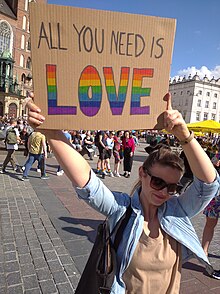
- During the Yep entrada of the Pablo Picasso purchase plebiscite of 1967, the slogan "All we need is Pablo" was used in reference to the song.[121]
- In February 1968, "All You Need Is Love" was played in the "Fall Out" episode of the Tv series The Prisoner, directed by Patrick McGoohan. Information technology was a rare instance of the Beatles licensing their music for utilize in another artist's film or tv set project.[122]
- Tony Palmer titled his 17-function television series All You lot Need Is Honey: The Story of Popular Music afterward the Beatles song.[123] The series, which commencement aired in 1977, included an episode ("Mighty Expert") defended to the band.[124]
- In 1978, the Rutles parodied "All You lot Need Is Love" in their song "Love Life"[98] and titled their television moving-picture show satirising the Beatles' history All You Need Is Greenbacks. Co-ordinate to New York Times journalist Marc Spitz, writing in 2013, this title was "really an attack" on the commercialisation of rock music by the late 1970s.[125]
- Harrison showed his enduring adoration for the song past referencing it in his 1981 tribute to Lennon, "All Those Years Agone".[126]
- Bob Geldof said he wrote the 1984 Band Help charity unmarried "Do They Know It's Christmas?" out of a wish to create "something that could be sung all effectually the world, like 'All You lot Need Is Love'". He too credited the Beatles' Our Earth performance as part of his inspiration for staging Alive Help in 1985.[116]
- At Live Aid on thirteen July 1985, Elvis Costello performed "All You Need Is Love"[127] before a television set audience estimated at upward to 1.9 billion.[128] Costello introduced it every bit an "old Northern English folk vocal"[129] and sang with a "vitriolic snarl", in Riley's description, that suggested "how far in that location all the same was to go rather than how far we'd come" in terms of realising the song's message.[130]
- "All You lot Need Is Love" was function of Queen Elizabeth Ii's archway music at the official millennium celebrations on 31 December 1999.[131] The Beatles' recording was played only before the midnight festivities at the Millennium Dome in London.[132] In 2002, the vocal was performed by choirs beyond Uk during the queen's Golden Jubilee celebrations.[131]
- To the dismay of many purists, a embrace version of the song was used in a 2007 advertizement for Procter & Gamble's Luvs baby production make.[131]
- In 2009, Global Beatles Day was founded as an international celebration of the Beatles' music and social message.[133] The event takes place on 25 June each year in retentivity of the Our World performance of the vocal.[133] [134]
- In October 2021, American vocalist Katy Perry released a encompass of "All You Need Is Love" for a Gap holiday ad.[135] [136]
Personnel [edit]
According to Ian MacDonald,[42] except where noted:
The Beatles
- John Lennon – lead and backing vocals, harpsichord, banjo
- Paul McCartney – bass, double bass, bankroll vocals
- George Harrison – lead guitar, violin, bankroll vocals
- Ringo Starr – drums
Additional participants
- George Martin – piano, orchestral arrangement, production
- Mike Vickers – usher
- Sidney Sax, Patrick Halling, Eric Bowie, John Ronayne – violins[137]
- Lionel Ross, Jack Holmes – cellos[137]
- Rex Morris, Don Honeywill – tenor saxophones
- David Bricklayer – trumpet
- Stanley Woods – trumpet, flugelhorn[39]
- Evan Watkins, Harry Espana – trombones
- Jack Emblow – accordion
- Mick Jagger, Keith Richards, Eric Clapton, Marianne Faithfull, Jane Asher, Pattie Boyd, Mike McGear, Keith Moon, Graham Nash, Hunter Davies, Gary Walker and others – background vocals
Charts and certifications [edit]
Notes [edit]
- ^ McCartney as well offered "Hello, Goodbye" for consideration.[12]
- ^ Lennon had too experimented with interpolating "She'll Be Coming 'Round the Mountain" during the coda.[39]
- ^ Photos of the band wearing these text boards were used on the single'due south picture sleeve in Italy and Japan.[fifty] The Italian artwork included the Our World logo and, for tape collectors, became the most sought-after of all the international sleeves for the unmarried.[51]
- ^ The idea to picture the functioning in the visitor of their friends and young man artists reprised the orchestral overdubbing session for "A Day in the Life" in February 1967,[55] [56] when the Beatles had hosted a happening-manner issue at EMI's Studio i.[57] MacDonald cites a tv set performance past Pink Floyd of their June 1967 single "Encounter Emily Play", when the band were "surrounded by a kaftan-clad crowd of beatific followers", equally a precedent.[58]
- ^ Starr recalled that his outfit was designed past the Fool especially for the event. It included a yellow sequin jacket with a fur collar and edging, and rings of beads around his neck; he said that together "it weighed a ton."[62]
- ^ Amidst a number of placards featuring the word "dear" translated into a multifariousness of languages, i sign read: "Come Back Milly". This was a plea to an aunt of McCartney'southward who was in Australia visiting her son and grandchildren.[38]
- ^ In a tone that Winn terms "facetious", Race announced that "The Beatles become on best with symphony men"[47] and Martin was "the musical brain behind all the Beatles' records".[56] In his commodity on the broadcast, for Rolling Rock in 2014, Gavin Edwards comments: "Annotation how as tardily as 1967, the institutional voice of the BBC was trying to make the Beatles more than palatable by challenge their affinity with classical musicians."[38]
- ^ In November 1967, Emerick prepared an extended version of "All You Need Is Dearest", lasting 4:30,[68] for its advent in Yellow Submarine.[102] Although the vocal's duration is only 2:42 in the film, the remix is evident from the inclusion of an actress chorus from which Emerick cut the saxophone riffs.[68]
- ^ Remixed by Giles and George Martin, this version includes elements from "Infant, You're a Rich Human being", "Sgt. Pepper's Lonely Hearts Club Ring", "Good Dark" and The Beatles' Third Christmas Record.[68]
- ^ When considering the island district scheme, Lennon and his bandmates were similarly oblivious to the political upheaval in Hellenic republic, three months after the country had become a fascist country.[86] [108] At the fourth dimension, he told the Beatles' official biographer, Hunter Davies: "I'm non worried well-nigh the political state of affairs in Hellenic republic, as long as information technology doesn't impact u.s.. I don't care if the government is all fascist or communist."[109]
- ^ For his part, Lennon said in a 1971 interview: "I think if you go downwards to nuts, whatsoever the problem is, it's usually to do with love. Then I think 'All Y'all Need Is Dearest' is a true statement ... Information technology doesn't mean that all you have to do is put on a phoney smile or wear a blossom dress and it'southward gonna be alright ... I'm talking about real love ... Love is appreciation of other people and assuasive them to be. Honey is allowing somebody to exist themselves, and that's what we exercise need."[12]
- ^ In The Beatles Anthology, Harrison describes "All You Demand Is Love" as "a subtle bit of PR for God".[12] [67]
References [edit]
- ^ Unterberger, Richie. "The Beatles 'All You Need Is Dear'". AllMusic. Archived from the original on 13 January 2011. Retrieved xx August 2011.
- ^ a b c Reising & LeBlanc 2009, p. 109.
- ^ "British Psychedelia". AllMusic. Archived from the original on 1 January 2011. Retrieved xxx July 2020.
- ^ a b c d Lewisohn 2005, p. 116.
- ^ a b Badman, Keith. "Universal Love". In: Mojo Special Express Edition 2002, p. 106.
- ^ Huntington, Tom (2006). "The Whole Earth'south Watching". Air & Infinite/Smithsonian. Smithsonian Institution. x (April/May 1996): 26. Bibcode:2006BuAtS..62a..26R. doi:10.1080/00963402.2006.11460953. Archived from the original on 25 February 1999. Retrieved 25 June 2014.
- ^ a b Schaffner 1978, p. 86.
- ^ Gould 2007, p. 426.
- ^ Hertsgaard 1996, pp. 223–24.
- ^ Lewisohn 2005, pp. 111, 116.
- ^ a b Hertsgaard 1996, p. 224.
- ^ a b c Womack 2014, p. 31.
- ^ Dowlding 1989, p. 188.
- ^ Womack 2007, p. 195.
- ^ a b Henke 2003, p. thirty.
- ^ a b Greene 2016, p. 36.
- ^ Hertsgaard 1996, p. 223.
- ^ Riley 2002, p. 162.
- ^ MacDonald 2005, p. 178.
- ^ Turner, Steve (July 1987). "The Beatles: Sgt Pepper, The Inside Story Part II". Q. Available at Rock's Backpages (subscription required).
- ^ Womack 2014, p. 1011.
- ^ Wolk, Douglas (27 Nov 2017). "'Magical Mystery Tour': Within Beatles' Psychedelic Album Odyssey". Rolling Stone . Retrieved xviii October 2018.
- ^ a b Womack 2014, p. 33.
- ^ a b The Beatles 2000, p. 257.
- ^ a b Jones 2014, p. 138.
- ^ Everett 1999, p. 124.
- ^ Everett 1999, pp. twoscore–41, 66.
- ^ Everett 1999, pp. 124–25.
- ^ Pedler 2003, p. 459.
- ^ Pedler 2003, p. 9.
- ^ Everett 1999, p. 125.
- ^ Pedler 2003, p. 720.
- ^ Reising & LeBlanc 2009, pp. 106, 109.
- ^ MacDonald 2005, pp. 260, 262.
- ^ Inglis 2010, pp. 10–11.
- ^ Gilliland, John (1969). "Sergeant Pepper at the Top: The very all-time of a very proficient year (testify 46, runway 2)". Pop Chronicles. UNT Digital Library. Retrieved 28 March 2020.
- ^ Pollack, Alan W. (1996). "Notes on 'All You lot Demand Is Dear'". soundscapes.info. Retrieved 8 October 2014.
- ^ a b c d e f one thousand h i j Edwards, Gavin (28 August 2014). "The Beatles Make History with 'All You Need Is Love': A Minute-past-Minute Breakdown". Rolling Stone . Retrieved 27 December 2015.
- ^ a b c d eastward Lewisohn 2005, p. 120.
- ^ Womack 2007, p. 197.
- ^ Greene 2016, p. 37.
- ^ a b MacDonald 2005, p. 261.
- ^ Hertsgaard 1996, p. 225.
- ^ a b Winn 2009, p. 110.
- ^ a b MacDonald 2005, pp. 261–62.
- ^ a b c d Lewisohn 2005, p. 117.
- ^ a b c d due east Winn 2009, p. 111.
- ^ Miles 2001, pic. section 2, p. 2.
- ^ Carr & Tyler 1978, p. seventy.
- ^ Schaffner 1978, p. 84.
- ^ Nash, Peter. "Money! It's What Nosotros Want!". In: Mojo Special Limited Edition 2002, p. 140.
- ^ Harris 2007, p. 89.
- ^ Norman 1996, p. 295.
- ^ Harris 2007, pp. 87–89.
- ^ Lewisohn 2005, p. 96.
- ^ a b Gould 2007, p. 427.
- ^ Harris 2007, pp. 76, 82.
- ^ MacDonald 2005, p. 262.
- ^ Harris 2007, pp. 88–89.
- ^ a b Miles 2001, p. 272.
- ^ Miles 2001, p. 271.
- ^ The Beatles 2000, pp. 256–57.
- ^ Miles 2001, pp. 270–71.
- ^ Frontani 2007, pp. 147–48.
- ^ Winn 2009, pp. 110, 111.
- ^ a b c Unterberger 2006, p. 178.
- ^ a b Unterberger 2006, p. 324.
- ^ a b c d e Winn 2009, p. 112.
- ^ Everett 1999, pp. 125–26.
- ^ Unterberger 2006, pp. 323–24.
- ^ Unterberger 2006, p. 179.
- ^ Rowe, Matt (18 September 2015). "The Beatles 1 To Be Reissued With New Audio Remixes … And Videos". The Morton Report. Archived from the original on 29 December 2015. Retrieved nine January 2016.
- ^ Castleman & Podrazik 1976, p. 62.
- ^ Winn 2009, p. 78.
- ^ Jones, Nick (8 July 1967). "Latest Message from the Beatles is 'Dearest'". Melody Maker. p. xiii.
- ^ a b "All You lot Need Is Love – The Beatles" > "Chart Facts". Official Charts Company. Retrieved 22 Oct 2018.
- ^ "Music Albums, Top 200 Albums & Music Album Charts". Billboard. 12 September 2008. Retrieved 22 June 2012.
- ^ Castleman & Podrazik 1976, pp. 62, 350.
- ^ Guesdon & Margotin 2013, p. 420.
- ^ Castleman & Podrazik 1976, p. 331.
- ^ Gould 2007, p. 431.
- ^ Schaffner 1978, pp. 85–86.
- ^ Simonelli 2013, p. 105.
- ^ Womack 2007, pp. 197–98.
- ^ Riley 2002, p. 233.
- ^ a b Norman 1996, p. 299.
- ^ a b Chase, Chris. "Fantasy Island". In: Mojo Special Limited Edition 2002, p. 109.
- ^ Miles 2001, pp. 273–74.
- ^ Hampson, Sam (12 January 2014). "Acid and Ukeleles: The Truth About The Beatles' Greek Island". Sabotage Times . Retrieved 18 March 2017.
- ^ The Beatles 2000, p. 259.
- ^ Everett 1999, p. 129.
- ^ Womack 2007, p. 196.
- ^ Rolling Rock staff (7 Apr 2011). "500 Greatest Songs of All Time: 370. The Beatles, 'All You lot Need is Honey'". rollingstone.com. Retrieved 13 March 2017.
- ^ Alexander, Phil; et al. (July 2006). "The 101 Greatest Beatles Songs". Mojo. p. 84.
- ^ Time Out London Music (24 May 2018). "The fifty All-time Beatles songs". Time Out London. Archived from the original on 15 December 2018. Retrieved 31 July 2019.
- ^ Castleman & Podrazik 1976, p. 63.
- ^ Greene 2016, pp. 41–42.
- ^ a b Womack 2014, p. 34.
- ^ Schaffner 1978, pp. 86, 99.
- ^ Womack 2014, p. 216.
- ^ Womack 2014, pp. 34, 216.
- ^ Unterberger 2006, p. 183.
- ^ Frith, Simon (1981). "1967: The Yr Information technology All Came Together". The History of Rock. Available at Rock'southward Backpages (subscription required).
- ^ Jones 2014, p. 139.
- ^ a b Carr & Tyler 1978, p. 68.
- ^ Wiener 1991, pp. 39–40.
- ^ Wiener 1991, pp. 40–41.
- ^ Doggett 2007, pp. 97–98.
- ^ Doggett 2007, p. 97.
- ^ Wiener 1991, pp. 37–38.
- ^ "Beatles' 'All You lot Demand Is Love' Lyrics Manuscript Sells For $1.25 One thousand thousand". Antiques and the Arts Weekly. 2 August 2005. Retrieved 9 May 2022.
- ^ Wiener 1991, pp. 305–06.
- ^ a b Hertsgaard 1996, pp. 226–27.
- ^ MacDonald 2005, p. 263.
- ^ Riley 2002, pp. 233–34.
- ^ a b Hunter-Tilney, Ludovic (28 July 2017). "All You Need Is Dearest: What Happened to the Global Popular Song?". Financial Times . Retrieved 28 January 2020.
- ^ Harrington, Richard (11 November 1987). "It Was 20 Years Agone Today". The Washington Post . Retrieved 21 March 2018.
- ^ a b Ellen, Marker (January 1988). "A Big Paw for the Quiet One". Q. p. 60.
- ^ Stossel, Scott (May 2013). "What Makes Us Happy, Revisited: A new look at the famous Harvard study of what makes people thrive". The Atlantic. Archived from the original on vii June 2017. Retrieved 25 June 2017.
- ^ CBC News Staff (31 July 2009). "Report proves Beatles right: All you demand is beloved". Canadian Dissemination Corporation. Archived from the original on 26 April 2017. Retrieved 25 June 2017.
- ^ Hess, Stefanie (vi October 2017). "The phenomenon of Picasso in Basel". Swissinfo. Archived from the original on vi October 2017. Retrieved 30 April 2021.
- ^ Perrone, Pierre (30 Baronial 2012). "Jailhouse rockers: How The Prisoner inspired artists from The Beatles to Richard Hawley". The Independent. Archived from the original on ii September 2012. Retrieved 18 October 2018.
- ^ Palmer, Tony (xviii April 2008). "Tony Palmer on John Lennon, Phil Spector, and How He Televised the Revolution". The Times . Retrieved 28 February 2021.
- ^ Badman 2001, pp. 209, 220.
- ^ Spitz, Marc (19 Dec 2013). "Rutlemania Is Dorsum, and Information technology's Unreal". The New York Times . Retrieved 16 Oct 2018.
- ^ Riley 2002, p. 243.
- ^ Jones 2014, pp. 139, 140.
- ^ Jones, Graham (6 July 2005). "Live Help 1985: A solar day of magic". CNN.com. Retrieved 16 October 2018.
- ^ Jones 2014, p. 134.
- ^ Riley 2002, p. 234.
- ^ a b c Fontenot, Robert. "The Beatles Songs: 'All You Need Is Love' – The history of this classic Beatles vocal (page 2)". oldies.about.com. Archived from the original on 5 April 2015. Retrieved 4 March 2020.
- ^ Badman 2001, p. 650.
- ^ a b Lifestyle Desk (25 June 2018). "Global Beatles Day: What is it and why is it celebrated". The Indian Express . Retrieved 11 Dec 2019.
- ^ Roterman, Natalie (25 June 2016). "Global Beatles Day Quotes: 25 Sayings to Remember I of the Biggest Bands of All Time". Latin Times . Retrieved 11 December 2019.
- ^ "Katy Perry Strums, Sings Beatles' 'All Yous Need is Love' in Vacation Gap Ad". Billboard. 25 October 2021. Retrieved 1 Nov 2021.
- ^ Zemler, Emily (26 Oct 2021). "Hear Katy Perry Cover the Beatles' 'All Y'all Need Is Honey'". Rolling Stone . Retrieved 1 November 2021.
- ^ a b Guesdon & Margotin 2013, p. 410.
- ^ "Go-Set Australian Charts – ix August 1967". poparchives.com.au. Retrieved 22 October 2018.
- ^ Worldcharts.co.britain. "Australia north°1 Hits – 60's". Archived from the original on 31 July 2013. Retrieved five July 2013.
- ^ "The Beatles – All You Need Is Love" (in German language). Ö3 Austria Top 40.
- ^ "The Beatles – All You Demand Is Love" (in Dutch). Ultratop 50.
- ^ Nyman, Jake (2005). Suomi soi 4: Suuri suomalainen listakirja (in Finnish) (1st ed.). Helsinki: Tammi. ISBN951-31-2503-3.
- ^ "All y'all need is dearest in Canadian Top Singles Chart". Library and Archives Canada. Archived from the original on 20 June 2017. Retrieved 5 July 2013.
- ^ a b "All you lot need is love in Irish Chart". IRMA. Archived from the original on 2 June 2009. Retrieved five July 2013. Only results when searching "All you need is beloved"
- ^ "Classifiche". Musica east dischi (in Italian). Retrieved 31 May 2022. Set "Tipo" on "Singoli". So, in the "Titolo" field, search "All y'all need is love".
- ^ "Nederlandse Pinnacle 40 – The Beatles" (in Dutch). Dutch Meridian 40.
- ^ "The Beatles – All Yous Need Is Love" (in Dutch). Single Top 100.
- ^ Season of New Zealand, 25 Baronial 1967
- ^ "The Beatles – All You lot Need Is Beloved". VG-lista.
- ^ "Swedish Charts 1966–1969/Kvällstoppen – Listresultaten vecka för vecka > Augusti 1967" (PDF) (in Swedish). hitsallertijden.nl. Retrieved 21 Feb 2018.
- ^ Hallberg, Eric; Henningsson, Ulf (1998). Eric Hallberg, Ulf Henningsson presenterar Tio i topp med de utslagna på försök: 1961-74. Premium Publishing. p. 53. ISBN919727125X.
- ^ "The Beatles: Awards" > "Billboard Singles". AllMusic. Archived from the original on 2 June 2012. Retrieved 23 October 2018.
- ^ Hoffmann, Frank (1983). The Cash Box Singles Charts, 1950–1981. Metuchen, NJ & London: The Scarecrow Printing, Inc. p. 32.
- ^ "The Beatles Single-Chartverfolgung (in German)". musicline.de. Archived from the original on 13 December 2013. Retrieved 20 September 2015.
- ^ "All You Demand Is Love – The Beatles (1987)". Official Charts Visitor. Retrieved 23 October 2018.
- ^ "Veckolista Heatseeker, vecka 53, 2015" (in Swedish). Sverigetopplistan. Retrieved 2 May 2021.
- ^ "RPM 100 Pinnacle Singles of 1967". RPM. Library and Archives Canada. Archived from the original on 12 August 2016. Retrieved 18 June 2016.
- ^ "Top 100 Hits of 1967/Top 100 Songs of 1967". musicoutfitters.com. Retrieved xviii June 2016.
- ^ "The Cash Box Year-Terminate Charts: 1967". Cashbox Archives. Archived from the original on 5 September 2012. Retrieved 18 June 2016.
- ^ "British single certifications – Beatles – All You Need Is Love". British Phonographic Industry. Retrieved 21 February 2020.
- ^ "American single certifications – The Beatles – All You Need Is Dear". Recording Industry Association of America. Retrieved fourteen May 2016.
Sources [edit]
- Badman, Keith (2001). The Beatles Diary Volume 2: Afterward the Pause-Up 1970–2001. London: Omnibus Press. ISBN978-0-7119-8307-6.
- The Beatles (2000). The Beatles Anthology . San Francisco, CA: Chronicle Books. ISBN0-8118-2684-8.
- Carr, Roy; Tyler, Tony (1978). The Beatles: An Illustrated Tape. London: Trewin Copplestone Publishing. ISBN0-450-04170-0.
- Castleman, Harry; Podrazik, Walter J. (1976). All Together Now: The Start Complete Beatles Discography 1961–1975. New York, NY: Ballantine Books. ISBN0-345-25680-8.
- Doggett, Peter (2007). There's a Riot Going On: Revolutionaries, Rock Stars, and the Rise and Fall of '60s Counter-Culture. Edinburgh, Uk: Canongate. ISBN978-1-84195-940-v.
- Dowlding, William J. (1989). Beatlesongs. New York, NY: Simon & Schuster.
- Everett, Walter (1999). The Beatles as Musicians: Revolver Through the Anthology. New York, NY: Oxford University Press. ISBN0-19-512941-5.
- Frontani, Michael R. (2007). The Beatles: Image and the Media . Jackson, MS: University Press of Mississippi. ISBN978-1-57806-966-8.
- Gould, Jonathan (2007). Can't Purchase Me Love: The Beatles, Britain and America. London: Piatkus. ISBN978-0-7499-2988-6.
- Greene, Doyle (2016). Rock, Counterculture and the Advanced, 1966–1970: How the Beatles, Frank Zappa and the Velvet Cloak-and-dagger Defined an Era. Jefferson, NC: McFarland. ISBN978-1-4766-6214-5.
- Guesdon, Jean-Michel; Margotin, Philippe (2013). All the Songs: The Story Behind Every Beatles Release. New York, NY: Blackness Domestic dog & Leventhal. ISBN978-1-57912-952-i.
- Harris, John (March 2007). "The Twenty-four hour period the World Turned Solar day-glo!". Mojo. pp. 72–89.
- Henke, James (2003). Lennon Legend: An Illustrated Life of John Lennon. San Francisco, CA: Chronicle Books. ISBN978-0-8118-3517-6.
- Hertsgaard, Mark (1996). A Day in the Life: The Music and Artistry of the Beatles. London: Pan Books. ISBN0-330-33891-9.
- Inglis, Ian (2010). The Words and Music of George Harrison. Santa Barbara, CA: Praeger. ISBN978-0-313-37532-3.
- Jones, Dylan (2014). The Eighties: I Twenty-four hours, One Decade. London: Windmill Books. ISBN978-0-099559085.
- Lewisohn, Marking (2005) [1988]. The Consummate Beatles Recording Sessions: The Official Story of the Abbey Road Years 1962–1970. London: Bounty Books. ISBN978-0-7537-2545-0.
- MacDonald, Ian (2005). Revolution in the Head: The Beatles' Records and the Sixties (2nd rev. edn) . Chicago, IL: Chicago Review Press. ISBN978-one-55652-733-3.
- Miles, Barry (2001). The Beatles Diary Volume 1: The Beatles Years. London: Omnibus Press. ISBN0-7119-8308-9.
- Mojo Special Express Edition: 1000 Days That Shook the World (The Psychedelic Beatles – April i, 1965 to December 26, 1967). London: Emap. 2002.
- Norman, Philip (1996) [1981]. Shout!: The Beatles in Their Generation. New York, NY: Fireside. ISBN0-684-83067-1.
- Pedler, Dominic (2003). The Songwriting Secrets of the Beatles. London: Omnibus Press. ISBN978-0-7119-8167-6.
- Reising, Russell; LeBlanc, Jim (2009). "Magical Mystery Tours, and Other Trips: Yellow submarines, newspaper taxis, and the Beatles' psychedelic years". In Womack, Kenneth (ed.). The Cambridge Companion to the Beatles. Cambridge, United kingdom of great britain and northern ireland: Cambridge University Printing. ISBN978-0-521-68976-2.
- Riley, Tim (2002) [1988]. Tell Me Why – The Beatles: Anthology by Album, Song by Song, the Sixties and After. Cambridge, MA: Da Capo Press. ISBN978-0-306-81120-three.
- Schaffner, Nicholas (1978). The Beatles Forever. New York, NY: McGraw-Hill. ISBN0-07-055087-5.
- Simonelli, David (2013). Working Class Heroes: Rock Music and British Society in the 1960s and 1970s. Lanham, Medico: Lexington Books. ISBN978-0-7391-7051-ix.
- Unterberger, Richie (2006). The Unreleased Beatles: Music & Film. San Francisco, CA: Backbeat Books. ISBN978-0-87930-892-half dozen.
- Wiener, Jon (1991). Come Together: John Lennon in His Fourth dimension. Urbana, IL: University of Illinois Press. ISBN978-0-252-06131-viii.
- Winn, John C. (2009). That Magic Feeling: The Beatles' Recorded Legacy, Volume 2, 1966–1970. New York, NY: Three Rivers Press. ISBN978-0-3074-5239-ix.
- Womack, Kenneth (2007). Long and Winding Roads: The Evolving Artistry of the Beatles. New York, NY: Continuum. ISBN978-0-8264-1746-half dozen.
- Womack, Kenneth (2014). The Beatles Encyclopedia: Everything Fab Four. Santa Barbara, CA: ABC-CLIO. ISBN978-0-313-39171-2.
External links [edit]
- Total lyrics for the song at the Beatles' official website
- The Beatles – All You lot Need Is Honey on YouTube
- "Katy Perry - All You Demand Is Love (Official Visualizer)" on YouTube
Source: https://en.wikipedia.org/wiki/All_You_Need_Is_Love
Posted by: voglnevill.blogspot.com
0 Response to "All You Need Is Love Film"
Post a Comment